Polarimetry
-
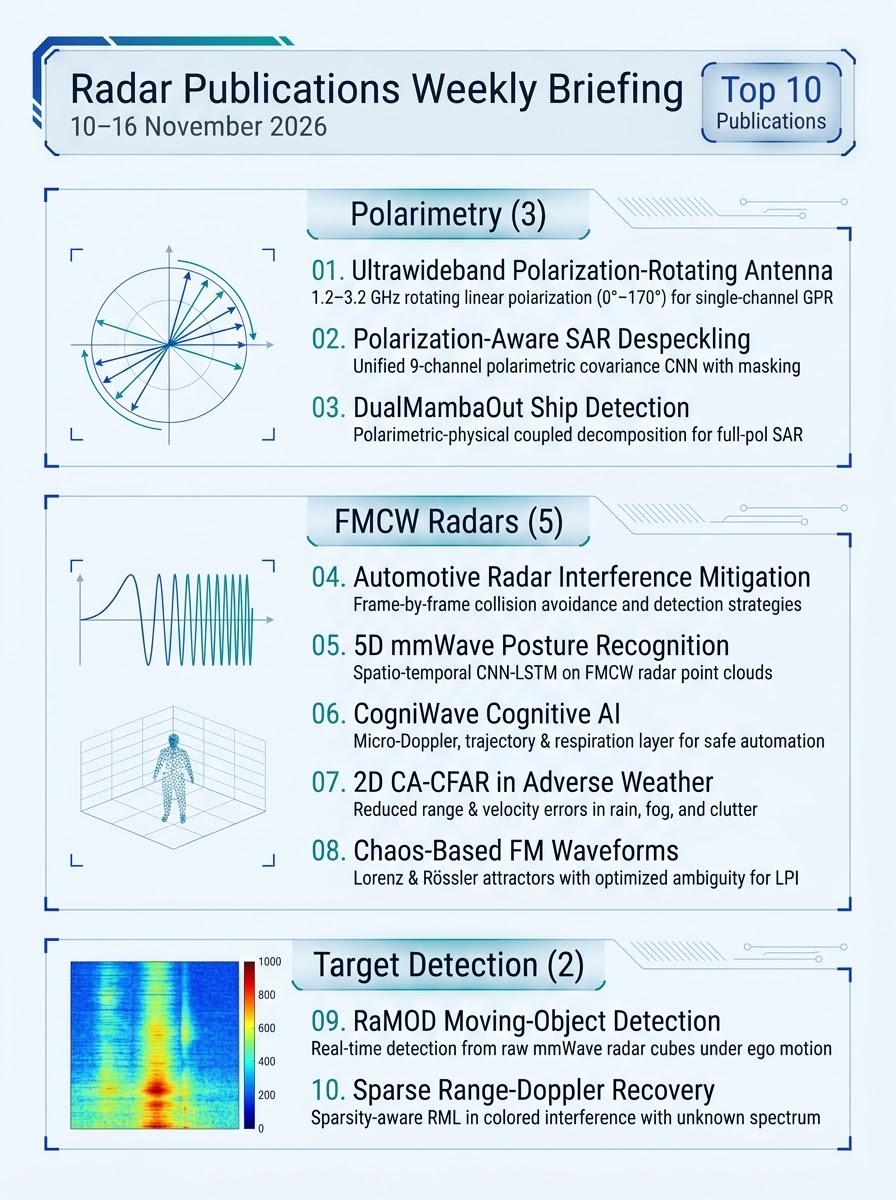
Ultrawideband Polarization-Rotating Antenna for Enhanced Ground Penetrating Radar Detection
A frequency-dependent ultrawideband antenna that continuously rotates linear polarization from 0° to 170° (1.2–3.2 GHz) improves detection consistency for polarization-sensitive subsurface targets in single-channel GPR systems.
https://arxiv.org/abs/2611.11523 (arXiv:2611.11523) -
Polarization Aware Deep Learning Framework for SAR Despeckling
A single convolutional network despeckles single-, dual-, and full-polarization SAR imagery via a unified nine-channel polarimetric covariance representation and polarization-aware masking.
https://arxiv.org/abs/2611.10091 (arXiv:2611.10091) -
A polarimetric-physical coupled DualMambaOut ship detection method
Couples multi-component polarimetric decomposition with a DualMambaOut architecture for improved ship detection in complex full-polarimetric SAR scenes.
https://doi.org/10.1360/SSI-2026-0010
FMCW Radars
-
Collision Avoidance and Collision Detection Strategies to Counteract Large-Scale FMCW Automotive Radar Interference
Frame-by-frame collision avoidance and collision detection strategies mitigate mutual interference among dense automotive FMCW radars, with trade-offs depending on available bandwidth.
https://arxiv.org/abs/2611.13214 (arXiv:2611.13214) -
Human continuous posture recognition based on FMCW millimeter wave radar point cloud with spatio-temporal network
A CNN-LSTM pipeline reconstructs continuous human posture from 5D FMCW mmWave radar point clouds, achieving lower joint position error than prior mmPose and MARS models.
https://doi.org/10.1007/s11760-026-05828-y
-
CogniWave: integrating cognitive AI and mmWave radar for human-centered intelligent automation
An FMCW mmWave radar framework extracts micro-Doppler, trajectory, and respiration features and feeds them into an uncertainty-aware cognitive layer for privacy-preserving activity recognition and safe automation.
https://link.springer.com/article/10.1186/s13634-026-01380-6 -
Enhancing FMCW radar accuracy for adaptive cruise control using CFAR algorithms in adverse weather
A two-dimensional CA-CFAR detector on FMCW radar reduces range and velocity estimation errors under rain, fog, and insect clutter for adaptive cruise control.
https://doi.org/10.1186/s43067-026-00414-1 -
Performance evaluation of chaos-based FM waveforms with optimized ambiguity functions against FMCW and noise radars in LPI applications
Chaos-based FM waveforms derived from Lorenz and Rössler attractors reduce interceptor coherent gain relative to conventional FMCW while preserving usable ambiguity functions.
https://doi.org/10.55092/esp20260006
Target Detection
-
RaMOD: Moving-Object Detection from Raw mmWave Radar Cubes under Ego Motion
A real-time framework detects and estimates velocities of moving objects directly from raw range-azimuth-Doppler cubes of a vehicle-mounted single-chip radar, handling ego-motion and Doppler wrapping.
https://arxiv.org/abs/2611.13271 (arXiv:2611.13271) -
Sparse Range-Doppler Profile Recovery in Colored Interference for Adaptive Radar
A unified sparsity-aware regularized maximum-likelihood framework recovers on-grid and off-grid range-Doppler profiles in the presence of correlated clutter with unknown spectrum.
https://arxiv.org/abs/2611.11810 (arXiv:2611.11810) -
CFAR Detection on Non-Coherently Integrated Angular Maps for mmWave Radio SLAM
Modified CFAR detectors operating on non-coherently integrated angular power maps improve multipath detection and positioning accuracy in beam-swept bistatic mmWave ISAC.
https://arxiv.org/abs/2611.14250 (arXiv:2611.14250) -
Lightweight graph transformers for clutter and target classification in automotive radar
Tiny graph transformer networks classify clutter versus stationary and moving targets in automotive radar scenes with accuracy comparable to larger models at far lower size and latency.
https://arxiv.org/abs/2611.04959 (arXiv:2611.04959) -
Injecting visual semantics into sparse radar: a sensor enhancement framework for robust 3D detection
Visual object queries distill high-level semantics into sparse radar points via contrastive learning and temporal memory, raising radar-only 3D detection mAP on nuScenes.
https://doi.org/10.1088/1361-6501/aebbe1 -
BladeSEI: A Multi-Channel and Multi-Day Dataset for Robust Specific Emitter Identification of Radars
A multi-channel, multi-day over-the-air dataset supports robust specific emitter identification of radar signals under realistic channel and hardware variations.
https://arxiv.org/abs/2611.18460 (arXiv:2611.18460)
Other Topics
-
Rethinking Radar 3D Perception: Representation Learning from Raw Spectra
A leakage-aware spectral masked autoencoder learns effective 3D perception representations directly from raw radar spectra without handcrafted reductions, outperforming point-cloud SSL baselines (accepted NeurIPS 2026).
https://arxiv.org/abs/2611.12334 (arXiv:2611.12334) -
A Four-Branch Radar Target Simulator with Fractional Delay on a PlutoSDR
An open-source ADALM-Pluto-based simulator generates up to four independent radar targets with fractional delays, Doppler, and gains for low-cost ISAC hardware testing.
https://arxiv.org/abs/2611.15674 (arXiv:2611.15674) -
RadarML: A Multi-Channel Over-the-Air Dataset of Common Radar Waveforms for ES Evaluation
A large publicly released multi-channel RFSoC-recorded dataset of approximately two million modulated radar pulses enables comparative modulation classification research.
https://arxiv.org/abs/2611.16786 (arXiv:2611.16786) -
VISTA: View-Independent micro-Doppler Reconstruction with Multistatic ISAC
A sparse-reconstruction method jointly processes multistatic ISAC measurements to recover absolute-frame micro-Doppler spectrograms independent of node geometry.
https://arxiv.org/abs/2611.16098 (arXiv:2611.16098) -
Improving Hail Diagnosis in Thunderstorms by Combining Radar and Lightning Detection Data
Fusion of X-band weather radar VILD products with a lightning-jump algorithm raises hailstorm detection rates in Southern Italy.
https://www.mdpi.com/2072-4292/18/22/3879 -
A Variational Autoencoder Network for Heartbeat Signal Reconstruction and Breathing-State Classification Using 24 GHz Radar Sensors
Dual 24 GHz radars plus a VAE-ResNet pipeline reconstruct heartbeat signals and classify breathing states with 99.7 % accuracy.
https://doi.org/10.3390/s26217083 -
Limited-Data Radar–Audio Fusion for Room-Level Intrusion Detection: Multi-Level Performance Evaluation and Cross-Environment Validation
Late fusion of low-power radar and audio sensors improves room-level intrusion detection F1-score under limited training data.
https://doi.org/10.3390/s26217095 -
Certified Dynamic Subspace Optimization for Bayesian ISAC Design
A certified dynamic transmit subspace method reduces the cost of Bayesian Cramér-Rao bound minimization for large-array angle estimation in ISAC while providing optimality certificates.
https://arxiv.org/abs/2611.16624 (arXiv:2611.16624)
SAR Papers (placed last)
-
Bistatic UAV-Based 3D SAR Imaging Using Integrated Sensing and Communications Transceivers
IEEE 802.11ad ISAC packets between a master and passive receiver UAV enable synchronization, motion compensation, and 3D tomographic SAR localization of complex targets.
https://arxiv.org/abs/2611.11956 (arXiv:2611.11956) -
Detecting space objects with Earth-observation radar satellites
Open Sentinel-1 voltage data reveal dozens of orbital objects at ranges of tens to hundreds of kilometres, illustrating the sensitivity advantage of close-range spaceborne radar.
https://arxiv.org/abs/2611.12158 (arXiv:2611.12158) -
XuanJian-DINOSAR: A SAR Foundation Model Based on Global and Local Semantic Consistency
Self-supervised adaptation of DINOv2 to more than 360 k SAR chips yields a foundation model with strong global and local semantic consistency under speckle.
https://arxiv.org/abs/2611.06105 (arXiv:2611.06105) -
Arctic-SAR: A Cross-Sensor RADARSAT Constellation Mission and Sentinel-1 Dataset and Fusion Benchmark for Multi-Task Sea Ice Mapping
A co-registered RCM–Sentinel-1 dataset and multi-task fusion benchmark support cross-sensor sea-ice concentration, stage-of-development, and floe-size mapping.
https://arxiv.org/abs/2611.08533 (arXiv:2611.08533)
Papers are ordered by priority: polarimetry, FMCW radars, target detection, then other topics (SAR last). Sources include arXiv, IEEE, Elsevier, and MDPI. Special thanks to Grok and Gemini.