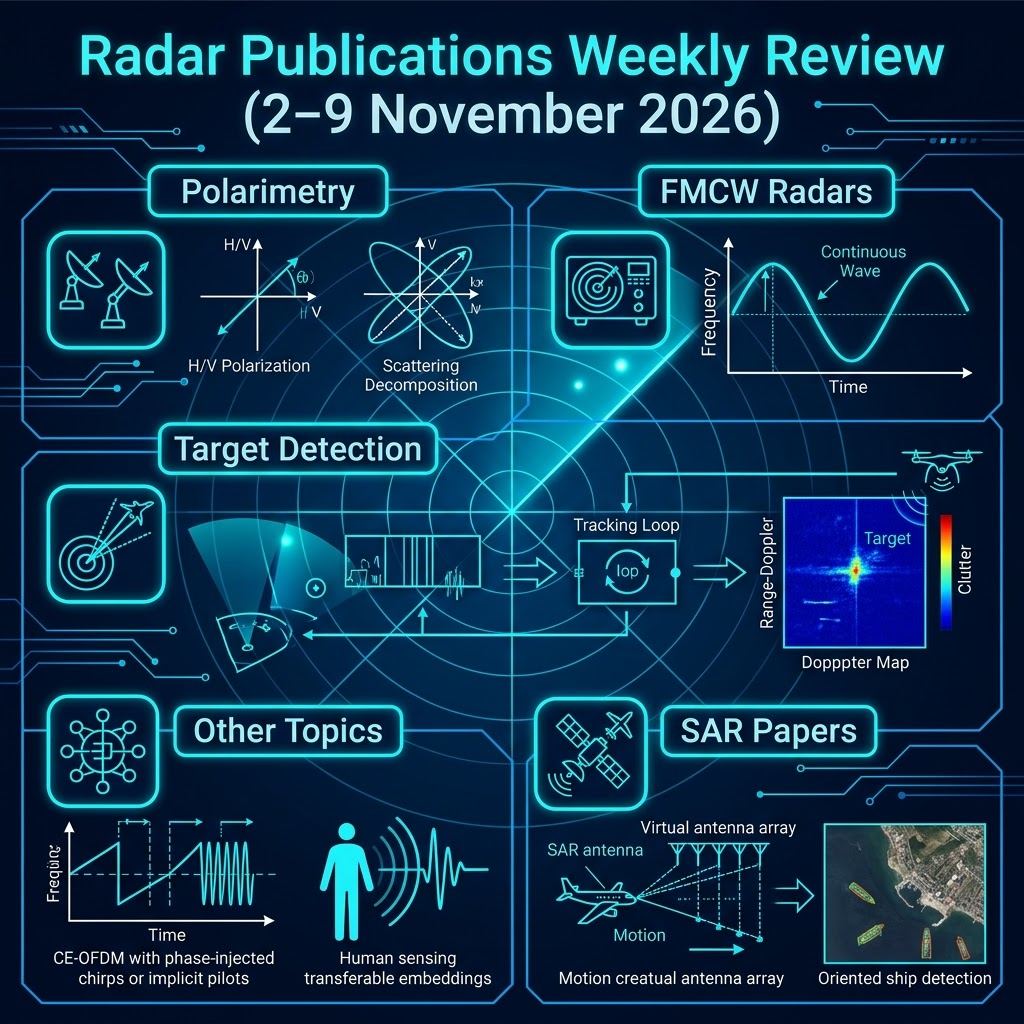
Polarimetry
- Polarimetric Scattering-Structure Contrastive Learning for Few-Shot HRRP Recognition
Polarimetric scattering-structure contrastive learning transfers physical scattering mechanisms into HRRP representations to improve few-shot recognition under aspect variation.
https://arxiv.org/abs/2611.04490
FMCW Radars
Prediction-Induced Sparsity for Tracked FMCW Radar: A Track-Conditioned Event-Gap FPGA Architecture
Prediction-induced sparsity conditions FMCW processing on track predictions to reduce computational load and power on FPGA hardware.
https://arxiv.org/abs/2610.41145AFDM-ISAC Design Amalgamating FMCW Radar and Carrier Aggregation
Carrier-aggregation-assisted AFDM waveforms with an FMCW-inspired dechirping receiver improve delay-Doppler sensing accuracy and resolution in ISAC systems.
https://arxiv.org/abs/2610.40107
Target Detection
6G ISAC Drone Detection: Signal Processing and Experimental Validation at FR1
Coherent and non-coherent ISAC detectors using clutter whitening and adaptive coherence estimation enable real-time drone tracking on a commercial base-station platform.
https://arxiv.org/abs/2611.05052Data-Driven Likelihood-Ratio Construction for Radar Detection via Bernstein Induction Operators
Data-driven likelihood ratios from clutter samples using Bernstein polynomials and induction operators improve weak-target detection in non-Gaussian sea clutter.
https://arxiv.org/abs/2611.06192Lightweight graph transformers for clutter and target classification in automotive radar
Tiny graph transformer networks classify clutter versus stationary and moving targets with far smaller model size and faster inference.
https://arxiv.org/abs/2611.04959Joint Data Association and Tracking for Surveillance Radar Using Gaussian Processes
Variational Bayesian joint data-association and tracking based on Gaussian processes outperforms Bernoulli and Kalman filters for weak drone targets.
https://arxiv.org/abs/2611.03314
Other Topics
Payload-Blind Bistatic Delay-Doppler Sensing with Phase-Injected Chirps in CE-OFDM
Injecting Zadoff-Chu chirps into CE-OFDM phase enables payload-blind bistatic sensing via residual carriers acting as implicit pilots.
https://arxiv.org/abs/2611.09687Reliable Bistatic Ranging With Unreliable Communication Payloads
Reliable bistatic ranging in ISAC by exploiting unrecoverable high-rate data payloads yields higher detection probabilities than pilot-only methods at low SNR.
https://arxiv.org/abs/2611.078034D Point Splatting for mmWave Radar Micro-Doppler Differentiable Rendering
Physics-based 4D point-splatting differentiable renderer fits explicit moving scenes to real mmWave radar captures for high-fidelity micro-Doppler simulation.
https://arxiv.org/abs/2611.08342A Universal Raw-IQ Radar Encoder for Cross-Sensor Human Sensing
Convolutional beta-VAE pretrained on raw IQ radar data from multiple platforms produces transferable embeddings for human sensing across unseen sensors and users.
https://arxiv.org/abs/2611.04534P-SER: Physical Consistency-Constrained Scattering Expandable Representation for Class-Incremental HRRP Target Recognition
Reconstructs scattering points from sum and difference HRRP channels to enforce physical consistency in an expandable representation for class-incremental recognition.
https://arxiv.org/abs/2611.04254CLOCs-R: Radar-Assisted Camera-LiDAR Fusion for Long-Range Object Detection
Adds accumulated radar returns to rescoring camera-LiDAR detections, providing modest mid-range gains on automotive datasets.
https://arxiv.org/abs/2611.04300
SAR Papers
High-order adaptive context association and domain-aware convolution for oriented ship detection in synthetic aperture radar images
YOLO-SARX with hybrid polarimetric convolutions, orientation-aware pooling, and high-order adaptive context modules improves oriented ship detection under speckle and clutter.
https://doi.org/10.1016/j.asoc.2026.116025A fast imaging method for moving vehicles in traffic radar based on second-order Keystone transform
Sub-aperture second-order Keystone processing enables real-time ISAR-style imaging of moving vehicles with millimeter-wave traffic surveillance radars.
https://doi.org/10.1016/j.dsp.2026.106395
Papers are ordered by priority: polarimetry, FMCW radars, target detection, then other topics (SAR last). Sources include arXiv, IEEE, Elsevier, and MDPI.