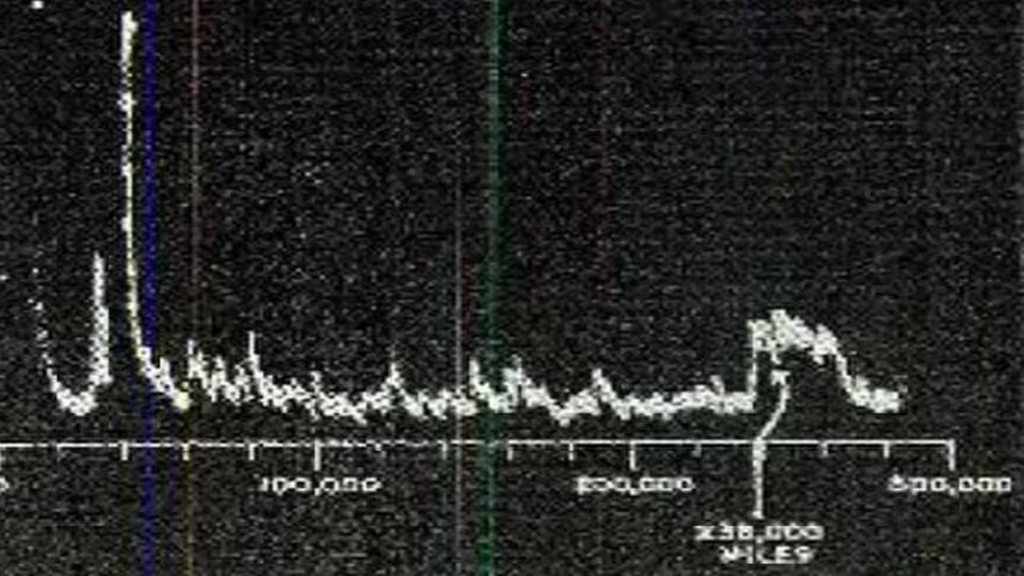
On January 10, 1946, a team of military and civilian personnel of the Project Diana at Camp Evans, Fort Monmouth, New Jersey, aimed a modified SCR-271 bedspring radar system at the rising Moon and transmitted high-power radio pulses in its direction. About 2.5 seconds later, the range-amplitude oscilloscope’s indicator for the first time in human history registered a faint radio echo that travelled to the Moon through the Earth’s atmosphere, outer space, reflected from the Moon’s surface, and returned to Earth.
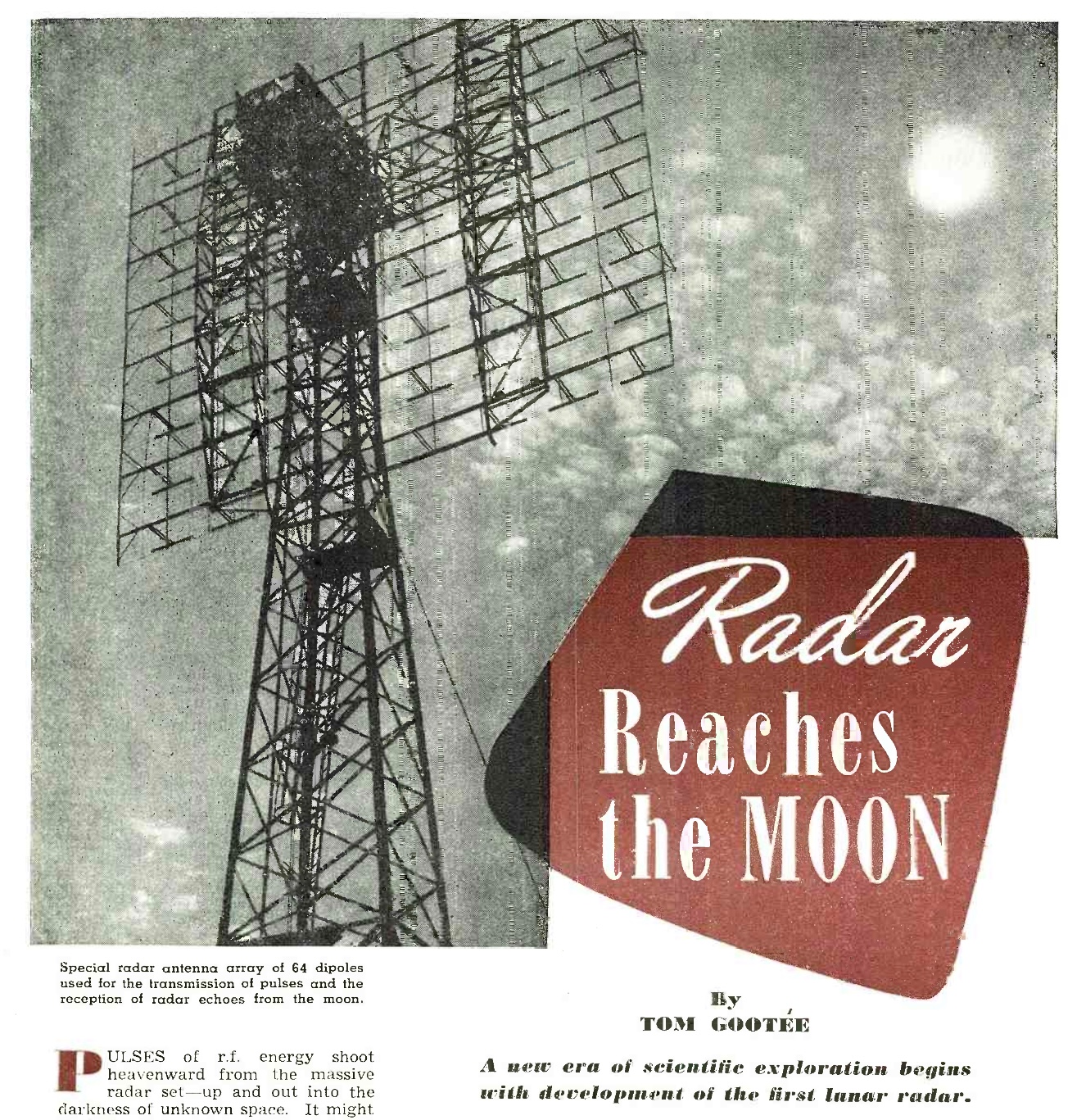
The radar was operating at the frequency 111.5 MHz, transmitted 15 kW pulses with 250 microsecond duration at a 1/3 Hz pulse repetition rate (one pulse per 3 seconds). It uses an enormous (40x40-foot, 12.2x12.2 meters) double bedspring antenna consisting of an 8x8 array of 64 half-wavelength dipoles with reflectors. Such an array has an antenna pattern with 15 degrees main beam and provides a still not too high gain of about 23 dB (200 times). In available specification (unfortunately, engineering specifications were destroyed by the Army in 1971, so the exact design details are unknown), the maximum Doppler shift of echo was mentioned as 327 Hz with a comment that it was set in the radar for a target at maximum range 980 MPH = 1577,16 km/h = 438,1 m/s (it has the exact Doppler frequency shift 326 Hz at 111.5 MHz frequency)…
More details about the project Diana can be found in the following sources:
- A personal website that is based on materials of the project’s veteran E. King Stodola
- Wikipedia
- an article “Radar Reaches the Moon” by Tom Gootee in the magazine Radio News, vol.35(4), April 1946 (available at WorldRadioHistory.Com)