IGARSS-2024, Athene

With Felix Yanovsky and Sebastian Torres we organized the special session “Signal and Data Processing in Atmosphere Remote Sensing I”, where presented with Tworit two papers:
  • Pinsky, M., Krasnov, O., Khain, A., Khain, P. “Retrieval of the convective clouds turbulence structure using high-resolution vertically pointed Doppler radar data” - DOI
  • Dash, T., Wenyi Lu, O. A. Krasnov and A. Yarovoy, “Detection of Precipitation Using Scanning Radars with Strong Sectorial Interferences” - DOI

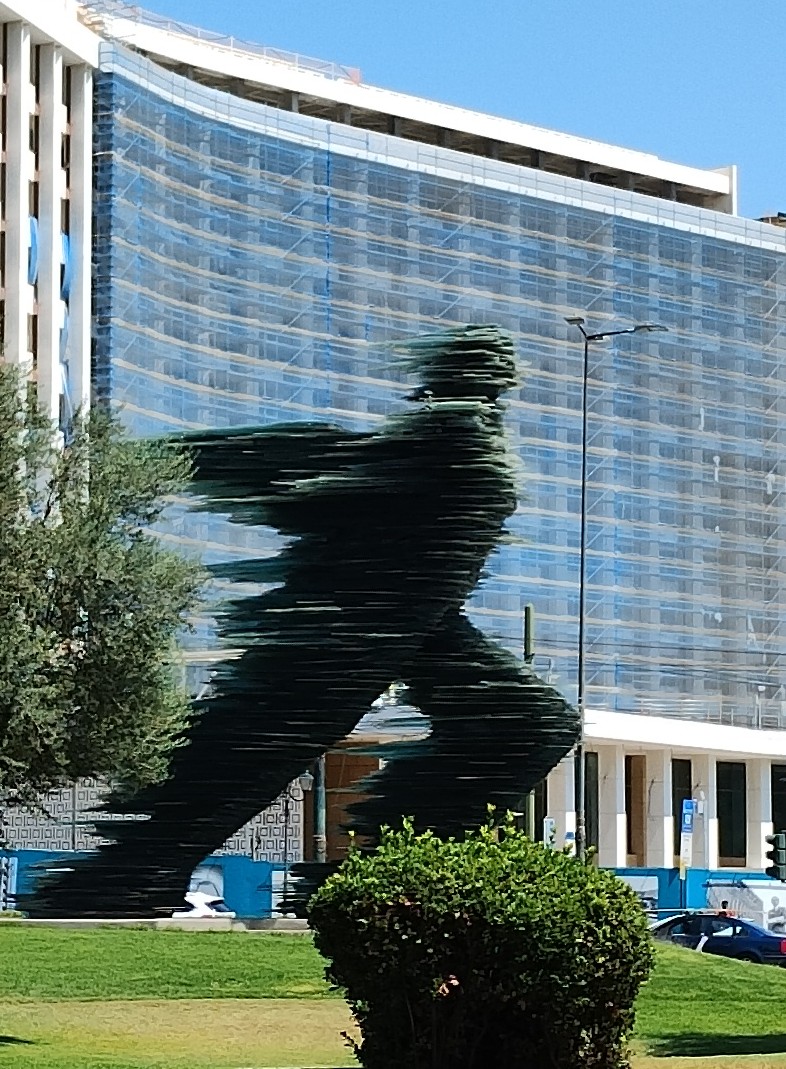
The Runner in Athens, Greece

Forward Model of Radar Signals in the Distributed Radar System

Finally, decided to published on the GitHub my radar network simulator, which where developed back to 2012…

RadarNet-FWM: Forward Model of Radar Signals in the Distributed Radar System

It is a simple MATLAB simulator of the set of non-directive radars that are working simultaneously but independently and observes the same set of targets. The simulator generates a timeline of coherently processed bursts of sensing waveforms with specified parameters, which are presented as a set of received signals on the range-Doppler plane.
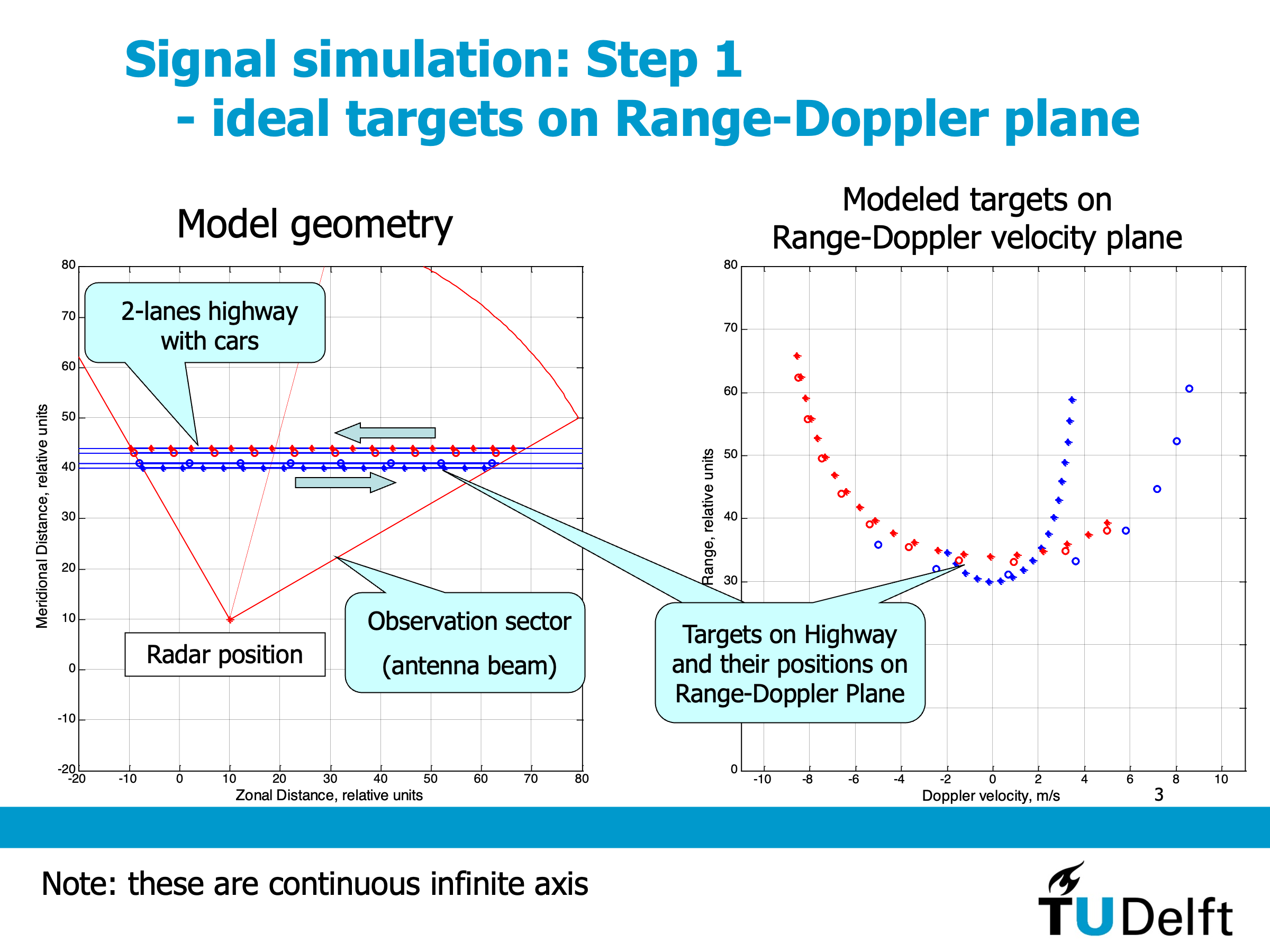

The slide with the model's concept explanation

EchoDyne's Counter-UAV Radars

This morning the LinkedIn brought an interesting photo of a small radar for drones detection:

The value of Echodyne radars cannot be understated. A compact unit, this system capable of accurately detecting, classifying, and tracking aircraft in its immediate vicinity. This system is optimal for teams needing a portable unit to watch over specific locations like public events.

It is developed by the Echodyne company. This small, tablet-sized radar provides precise 3D coordinates with fast update rate, has impressive characteristics, the promised easy-to-use APIs, flexible embedded software, and multiple data output options. It also has quite impressive capability for tracking drones at short ranges:

Echodyne radar tracking ranges for air targets

It also can be used even for weapon control at last stages:

EchoGuard radar control the gun

The radio wave propagation within the surface duct and the sinking of the Russian Black Sea Fleet cruiser Moskva

Accordingly to the recent publication in Forbes, in days and weeks after a Ukrainian navy anti-ship missile battery sank the Russian Black Sea Fleet cruiser Moskva on April 13, a lot of rumors circulated. Many of them attempted to explain how the Ukrainian navy, which does not have big ships or aircraft, could defeat a navy with lots of big and heavily - armed - vessels and planes. Some of the rumors hinged on the assumption that the Ukrainians required foreign help in order to strike Moskva.

But according to the cited in Forbes an eyebrow-raising new story in Ukrainska Pravda, the Neptune battery — a quad launcher and its associated radar — found and hit Moskva mostly on its own. The assistance the battery did receive from an atmospheric phenomenon called “temperature inversion” created a kind of channel for radar waves that allowed them to travel over the curve of the horizon and back.

Using the PETOOL Matlab package it is quite easy to visualize the standard situation of radar signals propagation above the sea surface. In standard situation that most often takes place during the spring in the Black Sea regions, the propagation factor (it is the factor that shows the value of attenuation of the transmitted signal that approaches a specific location and reflected back to the radar) is shown in Figure 1 using the logarithmic (decibels) scale.

Figure 1. The radio waves propagation factor in case of radar antenna installed at the height 3 m in a standard atmospheric conditions.)

Clear, that the strong attenuation (around 150 dB, 15 orders of power loss) of the signals from the ship that was at that time well below the radio-horizon, at the 120 km distance from the radar position, did not give a possibility to detect and track it, making impossible the operation of the Neptune battery.

But in the case of mentioned above “temperature inversion” the profile of the refractive index of atmosphere has very specific shape that radio-engineers called as the “surface duct”. In that case radio waves are propagating as in a waveguide for much longer distances. In this case the propagation factor looks quite different from the case of standard atmospheric conditions - see Figure 2.

Figure 2. The radio waves propagation factor in case of a radar antenna installed at the height 3 m in a "surface duct" conditions (the height of the inverse layer in this case equals to 20 m).

We see that inside the surface duct radar signal propagates between surface and upper limit of the inversion layer practically without serious attenuation. In such a case the huge ship at the distance of 120 km, well behind the radio-horizon, can be easily detected and destroyed using guided missiles.